Submit your product and get back a clear risk profile — which AI risks are active, how serious each is in your clinical context, and exactly where the gaps are. So you can close them before a buyer, auditor, or regulator finds them first.
Limited Alpha programme registrations open now - be the first to know your AI risk
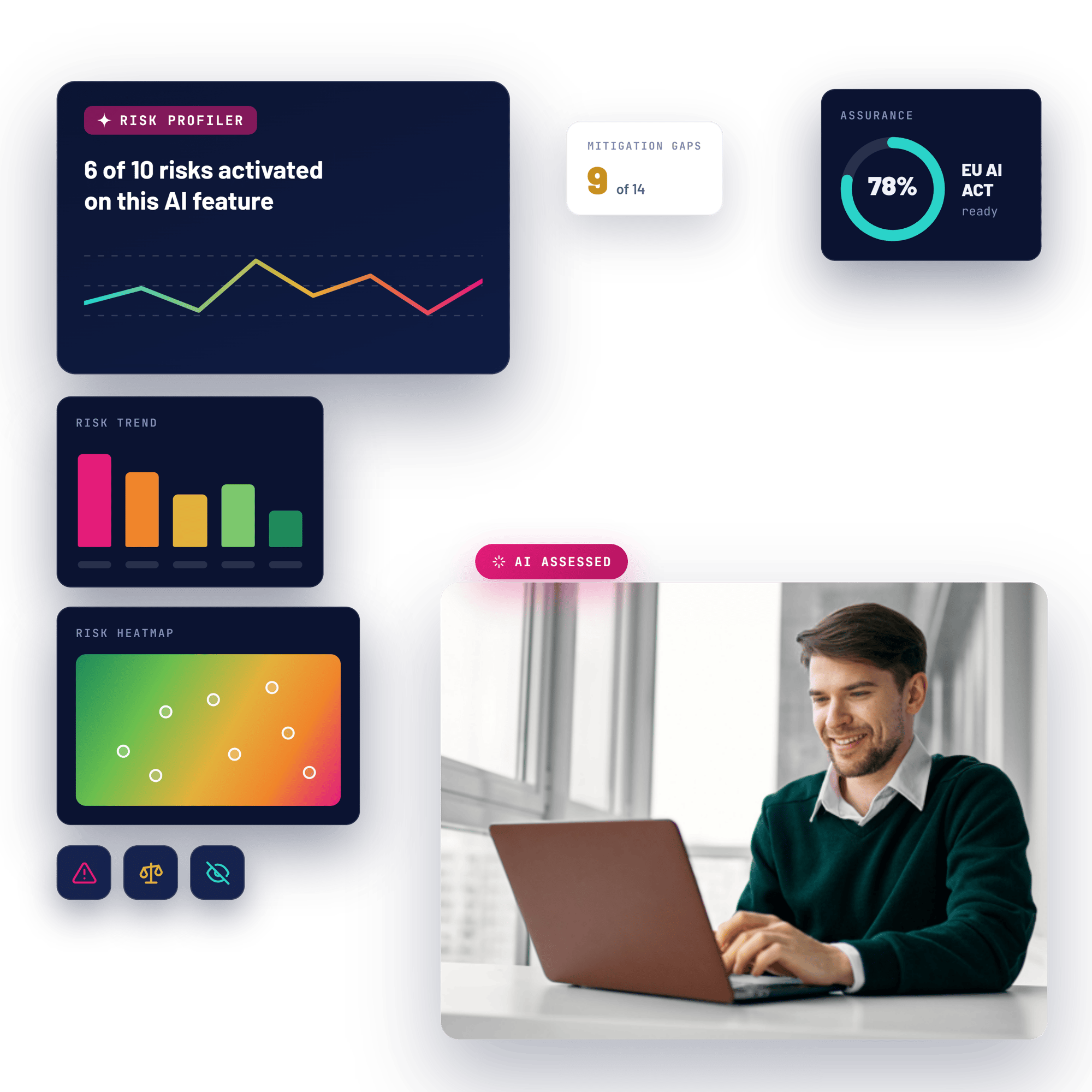
The AI Risk Profiler produces a structured risk profile for every AI feature in your product - the kind of document that answers the questions health system procurement teams and EU AI Act auditors are asking. Here's what the process looks like.
The report isn't a pass or fail. It shows which of the 10 'canonical' (standardised) AI risks are active, how severe each is given your clinical context, what you have in place to mitigate them, and where the gaps are.
What you can then do with the profile:

ORCHA Assured covers clinical safety, privacy, security, usability - broad assurance across any digital health product.
The AI Risk Profiler goes deeper into the AI-specific layer: the inference technique, the computational function, which of 10 standard risks those activate, and where the mitigations are absent. You can have an ORCHA Assured product that still carries unmitigated AI risks. The AI Risk Profiler is what finds them.
The EU AI Act has classified most clinical AI as high-risk, with mandatory documentation obligations live now. In the US, federal regulation is still developing — but the courts aren't waiting.
In the EU, non-compliance with the AI Act's high-risk obligations carries penalties of up to €30 million or 6% of global annual turnover. In the UK, DCB0129 clinical risk management obligations apply to every deploying organisation. In the US, the first cases are already in court. Disclaimers are not a defence.
maximum EU AI Act penalty
of global turnover
Each AI feature is assessed separately. By the end, you know which risks are active, how severe they are, what's mitigating them, and where the gaps are.
The risk profile is anchored in what's actually at stake — who receives the AI output and what happens if it's wrong. A wellness chatbot and a clinical decision tool get very different profiles. That distinction matters, and it's built in from the start.
A product with multiple AI features gets each one assessed separately. You don't get a single blended risk score that obscures where the real problems are - you get a clear picture of each feature individually.
How the AI works determines which risks it carries. Suppliers declare this through a structured questionnaire. If the declaration is incomplete or withheld, that's flagged — because opacity in documentation is a risk in itself.
You find out which of 10 defined AI risks are active in this product — and how serious each one is given the clinical stakes. Where two factors both trigger the same risk, you're told it's amplified. No guessing about what matters most.
You see what's actually reducing the risk — in the product architecture, and in the governance programme. Assessed separately, so you can tell whether a product is genuinely safe or just well-documented.
You leave knowing exactly where the unmitigated risks are and what they mean clinically. Not a pass or fail — a clear evidence base for making the decision in front of you, whether that's procurement, deployment, or regulatory submission.
The AI Risk Profiler framework has been validated against 20+ AI feature assessments across real health products. Every risk category and mitigation type reflects what's actually in the market - which means when it finds a gap in your product, that finding is grounded in evidence, not theory.
Read more about the research group here.
Expert institutions in the Advisory Steering Group across clinical, academic and technical backgrounds
Real AI health product features tested during framework development
A working paper co-authored with Ulster University and the American Psychological Association has been submitted to HHAI2026 - the Hybrid Human-Artificial Intelligence Conference in Brussels, July 2026. A peer-reviewed journal paper is planned for H2 2026.
of people globally now use AI to manage their health, making AI health products a mainstream clinical touchpoint, not a fringe use case.
of AI-fluent consumers believe they can perform at least one medical task as well as a trained professional. Perceived AI competence is outpacing governance.
year-on-year drop in public confidence in finding reliable health information. Trust in the health information environment is deteriorating fast.
Source: 2026 Edelman Trust Barometer Special Report: Trust and Health. 16,009 respondents across 16 markets.