/Logo%20-%20400x150.png?width=100&height=25&name=Logo%20-%20400x150.png)
/Icon/ORCHA%20Logo%20-%20Icon%20Full%20Colour%20-%20RGB.svg)
/Icon/ORCHA%20-%20Profile%20Icon%20-%20White.png?width=120&height=120&name=ORCHA%20-%20Profile%20Icon%20-%20White.png)

Beyond the Walls: Why Mental Health Providers Must Embrace Patient-Facing Digital Health
There are over 20,000 mental health apps available right now. Demand for digital mental health support has never been higher. And a lot of them are genuinely valuable and helpful tools to help.
So why do most of them never get recommended by a clinician, endorsed by a charity, or commissioned by a health system?
We put that question to Rosie Weatherley, Information Content Manager at Mind, and Chris Mosunic, Chief Clinical Officer at Calm Health, for an honest insight into what really makes a difference.
- You haven’t defined who you’re actually for
- You’ve ticked the compliance boxes but haven’t built credibility
- You built it without the people it’s for
- Evidence base alone won’t keep anyone coming back
- The app doesn’t fit into a care pathway
- The relationship was damaged before it started
1. You haven’t defined who you’re actually for
The mental health app market has a blurring problem. Wellness tools, clinical tools, digital therapeutics: they’re all lumped together, and suppliers often let that ambiguity sit. Recommenders don’t. Chris was direct about this: an app that positions itself as useful for mild, moderate, and severe mental health needs is, in practice, trusted for none of them. Clinicians and commissioners need to know exactly where a product sits on the care pathway before they’ll stake their reputation on it. Pick your lane. Design for it properly. The suppliers who get recommended are the ones who know exactly who they’re helping.
2. You’ve ticked the compliance boxes but haven’t built credibility
Getting through an assessment framework gets you to the starting line. It doesn’t get you recommended. Compliance tells a buyer you’ve met the minimum. The apps that earn real endorsement from organisations like Mind are the ones that demonstrate ongoing commitment: to quality, to users, to standards as they evolve. One-off compliance is a snapshot. Recommenders want to know what the picture looks like six months later.
3. You built it without the people it’s for
Rosie’s position was unambiguous. Mind looks for evidence of meaningful co-design with people who have lived experience of the problems an app is trying to solve. “Nothing about us without us” comes from the disability rights movement. It’s also a practical quality signal. Apps that haven’t been tested with real users in real conditions tend to solve the wrong problems, at the wrong level of complexity.
Rosie flagged this directly: an app can be technically sophisticated and still require more cognitive effort than a user in mental health difficulty can give. That’s a design failure. If you can’t point to how your users shaped the product, most serious endorsers will spot that gap.
4. Evidence base alone won’t keep anyone coming back
Chris made a point that gets overlooked: no engagement means no efficacy. An app can be clinically sound. If users don’t connect with it, don’t come back to it, don’t find it useful on a bad day as well as a good one, the outcomes don’t materialise. What Chris calls therapeutic alliance (the connection between a user and a tool they actually want to use) is what separates apps that work in trials from apps that work in practice. Recommenders who understand this aren’t just asking “is it evidence-based?” They’re asking “do people actually use it?”
5. The app doesn’t fit into a care pathway
The idea of “full stack mental health care” (one app that handles everything from subclinical wellness to crisis intervention) doesn’t survive contact with clinical reality. What recommenders want is an app that knows its place in an ecosystem. Where does it hand off? What happens when a user’s needs go beyond what the product can safely address? How does it work alongside the rest of the pathway?
Scope and interoperability are trust signals. An app with no thought for what comes before or after it creates risk, and commissioners are acutely aware of that.
6. The relationship was damaged before it started
This one is uncomfortable, but it came up clearly enough to be worth saying. How a supplier approaches an organisation like Mind matters. Bypassing established processes, persisting across multiple teams, ignoring replies: these don’t read as determination. They read as disregard for the time and the systems the organisation has built. Rosie described a specific case where a CEO’s approach to seeking Mind’s endorsement had the opposite effect. In a space where trust is foundational, that kind of impression is very hard to recover from.
The suppliers who build good relationships do the basics: they understand the organisation they’re approaching, respect existing processes, and come in with genuine curiosity about the problem.
Where assurance comes in
These aren’t niche problems, they’re the reasons most apps stall. ORCHA Assured gives recommenders the independent evidence they need to act: a rigorous assessment of quality, safety, and clinical standards, kept current as those standards move.
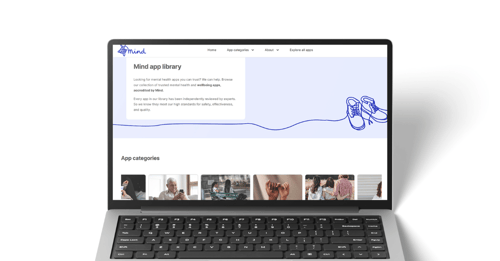
For mental health suppliers specifically, it’s also the route into schemes like the Mind App Library, where over a million people are actively looking for support.
Webinar On-Demand: Why good mental health apps don't get recommended
Watch the full session with Rosie and Chris, hosted by ORCHA's Jordan Hawkings.